Everything You Need to Reach Financial Independence
From compound interest to tax strategy, college funding to post-FI withdrawals — 62 articles across 11 topics.
Start hereA Lightning-Fast Introduction to Financial Independence→
FI Fundamentals

How Much Will Retirement Cost?
Your retirement number starts with one question: what will your life actually cost? Here's how to build a realistic expense estimate.

How Much Do I Need to Save?
The 25x rule gives you a starting target, but taxes, inflation, and debts shift the real number. Here's how to think about your FI number.

Navigating the Challenges of FI
The biggest obstacles between you and financial independence—and practical strategies to overcome each one.

How to Save Towards Your Number
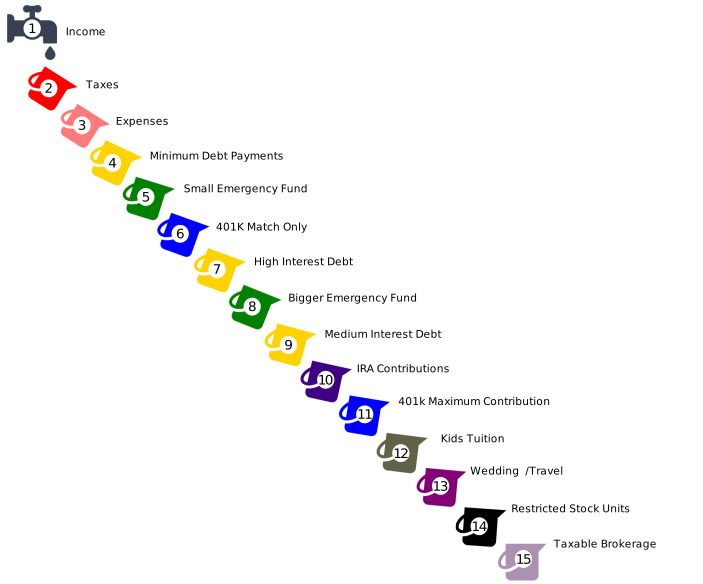
You have a target. Now where should each dollar go? A priority-based approach that funds the highest-impact step first.

Where to Put Your Money: Account Types 101
401(k), IRA, Roth, HSA, 529, taxable brokerage — what they are, how they're taxed, and why the distinctions matter for FI planning.
Why 25x Might Really Be 33x
The 4% rule ignores taxes on withdrawals. At higher spending levels, that blind spot can mean your FI number is 20-40% too low.

Coast FIRE, Barista FIRE, Lean FIRE, Fat FIRE — Explained
FIRE isn't one-size-fits-all. Understand the major variants, who they're for, and how to figure out which path fits your life.
Classic Net Worth vs Your FI Number
Your net worth and your FI number answer different questions. Understanding which assets actually count towards financial independence changes how you track progress.
Healthcare in Early Retirement
Pre-Medicare coverage is the cost that breaks plans. Understanding ACA subsidies, MAGI management, and how Roth conversions affect your premiums changes the math.
The Diminishing Returns of One More Year
Each additional year of work buys less safety than the last. At some point, the cost is measured in years of life — not dollars.
Mortgage Payoff vs. Invest
The math usually favors investing — but a paid-off home changes your sequence-of-returns risk by lowering the expenses your portfolio must cover.
What to Do With a Windfall
Inheritance, bonus, or stock vesting — a sudden influx of cash accelerates your FI timeline, but only if you have a framework for deploying it.
Your FIRE Number Is Not 25x Expenses
The 25x rule is a useful starting point — but it ignores taxes, healthcare, college savings, Social Security timing, and inflation. Here is what a real FI number accounts for.
Case Studies

How Much Faster Is the Fastest Path?
Same household, same income, same starting point. Six different financial strategies. The gap between the slowest and fastest path: 15 years.
Dual Tech Income: $530K and Still 7 Years Apart
A dual-tech-income couple earning $530K runs the same six paths. The surprise: investment optimization barely moves the needle. Spending discipline is what changes the timeline.
Single Income, $85K: Where Every Move Matters
On $85K with $55K in expenses, there is almost no margin for error. The spread between the worst and best strategy is 19 years — or the difference between never getting there at all.
Two Kids, One Goal: FI on $165K
A family of four earning $165K in North Carolina faces the widest spread of any archetype we've modeled. With $110K in annual expenses and two young kids, every dollar does double duty.
Starting at 42 With Almost Nothing Saved
A couple in their early 40s with almost nothing saved runs six paths to FI. When time is short, every decision is amplified — and only one path gets them there before 65.
$250K Income, $180K in Student Debt
A California couple earning $250K carries $180K in student debt and pays some of the highest state taxes in the country. We ran six paths to see how long financial independence really takes when debt service and taxes compress every dollar.
Community & Ecosystem

We Love the Reddit FIRE Community
The Reddit FI community built something extraordinary. Here's how MoneyOnFIRE builds on their wisdom to turn general guidance into your personalized plan.
Bogleheads Philosophy Meets Actionable Planning
The Bogleheads community taught us how to invest wisely. MoneyOnFIRE helps you put that wisdom into a personalized, month-by-month plan.
College Series

Part 1: How Much Do You Need for College?
A step-by-step guide to integrating college savings into your financial independence journey.

Part 2: Accounting for Inflation
Converting today's college costs into the future dollars you'll actually need to save

Part 3: How do we solve?
Using time and compound growth to reach your inflation-adjusted college savings goal

Part 4: Where to Save for College
Understanding 529 plans and other college savings strategies

Choosing the Best 529 Plan
How to compare 529 plans on fees, state tax benefits, and investment options—and which ones consistently rank at the top.

Part 6: College and Your Financial Independence
Which one do you prioritize?
The One Where They Retire
We build financial profiles for the cast of Friends based on show canon and run them through the MoneyOnFIRE planning engine. The characters are fictional, but the financial math is real — NYC taxes, 2026 contribution limits, Monte Carlo simulations, and all.

The One Where Monica and Chandler Retire
Monica's head-chef ceiling meets Chandler's career restart. We ran both paths through the engine — and the cost of following your passion is about 3 years.

The One With Three Divorces and a Fashion Career
A tenured professor and a fashion executive with $275K combined income. NYU's 10% 403(b) match is the secret weapon — but three divorces and expensive taste are the anchors.

The One Where Phoebe and Mike Win
A massage therapist and a pianist with $120K combined income. They reach FI before everyone — including the $275K household. The secret: a decade of BigLaw savings and a lifetime of not caring about money.

The One Where Joey Needs a Financial Plan
A $72K income in NYC, $20K in credit card debt, and zero savings at 35. Joey's problem was never how much he earned — it was what he did with it.
Thought Pieces

We Love Our Kids—But How Much Do They Delay FI?
Children bring joy and meaning, but they also change your financial independence timeline. Here's how to think about the tradeoffs.

Not Just for Early Retirees
Financial independence isn't just for people who want to quit at 35. The advice works whether you're aiming for 45, 55, or 67. The real question isn't when you retire. It's how you get there fastest.
Reading Your MoneyOnFIRE Report

Building a Budget That Supports Financial Independence
Set up expense tracking to keep your real spending aligned with your MoneyOnFIRE plan

The Importance of Rebalancing Your Accounts
How to execute the transfer instructions in your MoneyOnFIRE action plan

Building Your Emergency Fund in Two Stages
Why your plan splits emergency savings into an initial fund and a full fund

Managing RSU Vests in Your FI Plan
What to do each time shares vest — sell, verify withholding, and avoid concentration risk

Understanding Our Approach to Managing Debt
How MOF prioritizes high-interest debt to fast-track your financial independence

Setting Up Your Taxable Brokerage Account
How to open, fund, and invest in the account that bridges your savings phase to financial independence.
Understanding Your College Savings Results
What your plan's college section means — contribution targets, plan selection, and how college funding fits into your FI timeline

Enrolling in Your 401(k) and Capturing the Employer Match
How to enroll, choose pre-tax or Roth, and pick the best investments from your plan menu

Opening Your 529 Plan
How to open the 529 plan your MoneyOnFIRE report recommended, select investments, and set up contributions.
IRA Contributions: Choosing and Funding Your Account
How to open your IRA, fund it, and choose low-cost investments that match your FI plan
Reviewing and Rolling Over Old 401(k) Accounts
How to consolidate old employer retirement accounts into a rollover IRA
Maxing Out Your 401(k) Contributions
Why and how to contribute the full annual limit to your employer retirement plan
Umbrella Insurance: Protecting Your Growing Wealth
Why an umbrella policy is an essential safeguard as your net worth increases
Term Life Insurance for Your FI Plan
How to choose the right coverage amount and term length to protect your family during the accumulation phase
Estate Planning Essentials for Your FI Journey
How to set up a will, designate beneficiaries, and consider a trust to protect your family and assets
Maths and Mechanics

The Power of Compound Interest
Discover how the power of compound interest can dramatically accelerate your path to financial independence—and why every year counts.

The Hidden Cost That's Stealing Your Retirement
How a 1% fee difference costs the average investor $590,000 over 30 years—and why most people never notice until it's too late.

The 4% Rule: What It Gets Right—and What MOF Does Better
Discover the strengths and shortcomings of the 4% rule and how MOF improves on it with personalized, tax-aware, and inflation-aware FI planning.

Inflation Makes FI a Moving Target
Your FI number isn't static — it grows every year with inflation. Here's how to think about what that means for your plan.

Why Tax-Advantaged Accounts Come First
The waterfall tells you what order to fund accounts — but why that order? The answer is a simple grid of tax properties that makes the priority order intuitive.

Sequence of Returns Risk: Why Your First Years Matter Most
Two retirees with the same average return can have wildly different outcomes. Here's why the order of returns matters — and what you can do about it.
Savings Rate vs. Return Rate: Which Moves Your FI Date?
Early in your journey, saving more matters most. Later, returns take over. The crossover point changes everything about where to focus your energy.
When the 4% Rule Breaks Down: SWR for FatFIRE
FatFIRE breaks the assumptions behind the 4% rule — longer horizons, higher tax drag, and concentrated positions all change the math. But discretionary spending flexibility changes it back.
Is 4% Safe for a 50-Year Retirement?
The Trinity Study tested 30-year periods. If you retire at 35, you need 50-60 years of income. A fixed withdrawal rate is the wrong tool — but a full simulation is not.
Planning

Planning for Life's Twists and Turns
Your FI plan was built on assumptions. Scenario analysis shows you what happens when those assumptions change.
Social Security Claiming Strategy for Early Retirees
Delaying Social Security from 62 to 70 is an 8% annual guaranteed raise. For early retirees, the bridge strategy — spending down your portfolio first — can be the optimal play.
Engineering

Why we moved from AWS to Vercel
Our motivation and experience migrating a compute-intensive financial planning engine from AWS to Vercel

Vibe Coding a CMS
How we built MoneyOnFIRE's content system with AI-assisted development — and then leveraged AI within tight guardrails to assist with content
Ready to build your plan?
Use MoneyOnFIRE to see exactly how different strategies affect your timeline to financial independence.
Build My Plan