
The Flowchart That Started It All
If you're reading this, chances are you've already discovered one of the greatest free resources in personal finance: the FIRE Flow Chart (Version 4.3) from Reddit's r/financialindependence community.
This flowchart is a masterpiece. It represents years of collective wisdom from thousands of people who have walked the path to financial independence. The community has distilled complex financial decisions into a clear, logical sequence that anyone can follow.
We Stand on the Shoulders of Giants
The Reddit FI community created something truly special. The flowchart has helped millions of people understand the right order to tackle their finances. We're not here to replace it—we're here to help you execute it.
View the original FIRE Flow Chart 4.3 on RedditThe flowchart tells you the right order to do things:
- Pay off high-interest debt before investing
- Capture your employer 401(k) match before maxing your IRA
- Build an emergency fund before attacking medium-interest debt
- Max tax-advantaged accounts before taxable brokerage
This prioritization is exactly right. MoneyOnFIRE follows the same logic because it works.
The Natural Next Questions
Once you understand the flowchart, you're ready to take action. But action requires specifics. The flowchart brilliantly answers "what should I do?"—and naturally, the next questions are"how much?" and "when?"
These aren't gaps in the flowchart—they're personal questions that depend on your specific situation:
"Exactly how much should I contribute each month?"
The flowchart says "get the employer match"—but what's the dollar amount for your specific salary and match percentage? And after that step, how much goes to the next priority?
"When will I actually achieve FI?"
You know the steps—but how do they add up over time? When will you hit your FI number? The flowchart guides your priorities; a projection tool shows your destination.
"How do taxes affect my plan?"
Federal, state, FICA—your actual take-home pay determines how much you can allocate to each step. Calculating taxes unlocks the real numbers.
"How do I balance FI with other goals like college savings?"
The flowchart shows where 529s fit in the priority order. But how much should go there while still making progress toward FI? That takes some math.
That's Where MoneyOnFIRE Comes In
Think of MoneyOnFIRE as the execution layer for the flowchart. We take the same battle-tested priority order that the Reddit community refined over years, and we add the personalization layer that turns general wisdom into your specific action plan.
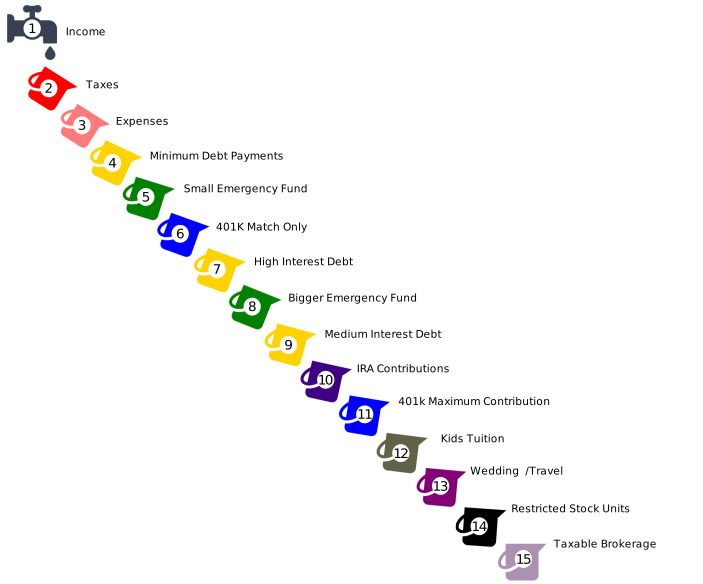
Our waterfall follows the same logic the community recommends:
- Taxes — Calculate your actual take-home pay
- Essential expenses — Housing, food, utilities
- Minimum debt payments — Stay current on all accounts
- Small emergency fund — $1,000 or one month of expenses
- 401(k) employer match — Capture that free money
- High-interest debt — Eliminate the expensive stuff first
- Full emergency fund — 3-6 months of expenses
- Medium-interest debt — Student loans, car payments
- IRA contributions — Up to the annual max
- 401(k) max — Beyond the match
- College savings (529) — If you have kids
- Taxable brokerage — Build wealth beyond tax-advantaged limits
What We Add to the Flowchart
The flowchart gives you the strategy. We give you the tactics—personalized to your situation.
Your Exact Numbers
Not "contribute to your 401(k)" but "contribute $542/month to your 401(k) starting in March." Specific amounts based on your income, expenses, and goals.
Your Timeline
See when you'll complete each step: emergency fund funded by June, debt-free by 2027, financially independent by age 52.
Tax Calculations
We calculate federal, state, Social Security, and Medicare taxes. Your real take-home pay is the starting point for everything else.
Your FI Number
We calculate your personal FI number — going beyond the 4% rule — based on your expected retirement expenses, adjust for inflation, and project when you'll reach it.
Multi-Goal Balancing
Saving for college and FI at the same time? We calculate the right split so you can reach both goals without sacrificing either.
Actionable Steps
Get a checklist with specific actions: "Increase 401(k) contribution to 8%," "Open Roth IRA at Fidelity," "Set up $400/month auto-transfer to emergency fund."
Better Together
The flowchart and MoneyOnFIRE aren't competing—they're complementary. Here's how they work together:
| You Need | Flowchart Provides | MoneyOnFIRE Adds |
|---|---|---|
| Priority order | The right sequence of steps | Same sequence, applied to your numbers |
| Contribution amounts | "Get the match," "Max it out" | $542/month, $750/month, etc. |
| Timeline | Not addressed (not its purpose) | FI by age 52, debt-free by 2027 |
| Tax impact | Mentions tax-advantaged accounts | Calculates your actual taxes |
| Ongoing guidance | Reference when making decisions | Month-by-month projections |
Month-by-Month Simulation
MoneyOnFIRE simulates your entire financial journey, month by month, following the flowchart's priority order. This means you can see:
Every Month
How your accounts grow through compound interest as you follow the steps
Key Milestones
When you complete each phase of the flowchart
The Destination
When following the flowchart gets you to FI
A Thank You to the Community
We built MoneyOnFIRE because we believe in the FI movement and the incredible resources the community has created. The flowchart taught us the right way to think about financial priorities. We hope MoneyOnFIRE helps you put that wisdom into practice.
Key Takeaways
- The Reddit FI flowchart provides the correct priority order for financial decisions, from debt payoff through tax-advantaged account maximization.
- The flowchart answers what to do; a planning tool like MoneyOnFIRE answers how much and when, based on your specific income, expenses, and goals.
- Tax calculations are essential to determine your real take-home pay, which is the starting point for allocating money across each flowchart step.
- A month-by-month simulation turns general flowchart guidance into a personalized timeline with specific dollar amounts and milestone dates.
Ready to Put the Flowchart Into Action?
You know the steps. Let us calculate the numbers. Get your personalized roadmap based on the same priorities the FI community recommends.
Build My Personal Plan