Eliminate debt strategically — and reach FI faster
Being debt-free is a prerequisite for financial independence — but paying off debt too aggressively can slow you down. MOF uses a prioritized waterfall to balance debt paydown against investing, so every dollar goes where it matters most.
Build My PlanDebt-free is a prerequisite to financial independence
You can't be financially independent while carrying debt. Either you need to pay it off before you stop working, or your FI portfolio needs to be large enough to cover the ongoing payments — which means a bigger target number and more years of saving.
Debt service eats directly into the passive income your portfolio generates. A $500/month car payment at a 4% safe withdrawal rate requires an extra $150,000 in your portfolio just to keep up. That's years of additional saving and investing.
The flip side is powerful: every dollar of debt you eliminate is a dollar less your portfolio needs to produce. Paying off a $20,000 loan doesn't just remove the balance — it permanently reduces your FI target.

The tension: paying off debt vs. investing toward FI
Debt paydown and investing compete for the same limited cash flow. You have a finite amount of money each month after covering essentials, and both priorities have legitimate claims on it.
- Pay debt too aggressively → you miss your employer match, tax-advantaged growth, and years of compounding
- Pay too slowly → high-interest balances compound against you, quietly eroding your net worth
The right answer depends on the interest rate of each debt relative to expected investment returns. A 22% credit card balance should be eliminated immediately — the guaranteed "return" of removing that interest far exceeds anything the market offers. But a 3.5% mortgage? The expected long-term return on invested capital is roughly double the borrowing cost.
This is the core insight: you need a system that weighs the cost of each debt against the opportunity cost of not investing — and adjusts as your situation changes.
The financial waterfall: where debt fits in
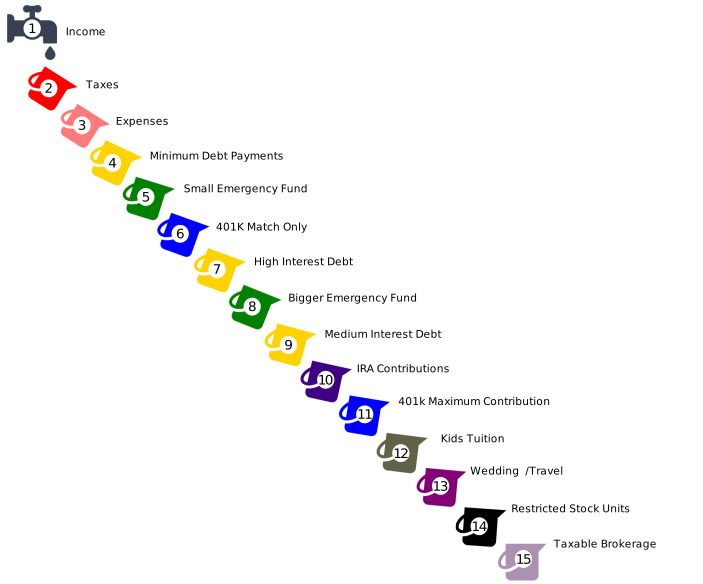
MOF uses a prioritized financial waterfall — the same approach recommended by the FI community — to determine where every dollar should go. Debt paydown is woven into this sequence at exactly the right points:
- 1Taxes & essential expenses
- 2Minimum debt payments on all debts
- 3Small emergency fund ($1k / 1 month)
- 4401(k) employer match
- 5High-interest debt paydown
- 6Full emergency fund (3–6 months)
- 7Medium-interest debt paydown
- 8IRA, 401(k) max, 529, brokerage
Within each debt tier, MOF uses the avalanche method: minimums on all balances, with every extra dollar directed to the highest-rate debt first. Low-interest debt (like most mortgages) gets only minimum payments — the money is better deployed investing.
Category by category: how MOF handles each type of debt
Credit cards
Almost always high-interest. Credit card debt is tackled aggressively — before even building a full emergency fund. The guaranteed "return" of eliminating 20%+ interest far exceeds any investment. Example: $10,000 at 22% costs $2,200/year in interest alone. Paying it off is equivalent to earning a 22% risk-free return.
Personal loans
Typically high or medium interest depending on the rate. MOF classifies personal loans relative to the prime rate and slots them into the waterfall accordingly — high-rate personal loans are treated like credit cards, while lower-rate ones are addressed after the emergency fund.
Student loans & auto loans
Usually medium interest. These are paid down after the emergency fund but before maxing retirement accounts. The rate is high enough that accelerated paydown is worthwhile, but not so high that it should override capturing tax-advantaged investment growth.
Mortgage
Usually low interest. MOF tracks the balance and models payments as housing costs but doesn't prioritize extra paydown. At typical mortgage rates, expected long-term investment returns exceed the borrowing cost, so your cash is better deployed elsewhere. The balance is tracked year by year and factors into your net worth and FI calculation.
Low-interest debt: save and invest instead of paying it off early
Not all debt deserves aggressive paydown. When the interest rate on a debt is low enough — typically below expected long-term investment returns — accelerating payments actually slows your path to FI. The money does more work invested in the market than it saves in interest.
Instead of throwing extra cash at a low-rate mortgage or subsidized loan, MOF continues making the scheduled minimum payments and directs the surplus into savings and investments. The key difference: MOF earmarks a portion of another account to cover the remaining debt balance.
How earmarking works
Say you have a $200,000 mortgage at 3.5%. Rather than making extra payments, MOF invests your surplus cash and tracks how much of your investment portfolio is "spoken for" by the remaining mortgage balance. As you invest and the loan amortizes, your net position — investments minus earmarked debt — grows faster than it would if you'd paid the mortgage down directly. You still owe the debt, but you have more than enough set aside to cover it at any time.
This means your FI calculation accounts for the debt without penalizing you for carrying it. MOF subtracts the earmarked amount from your investable portfolio when computing your FI number, so the math stays honest — but the total grows faster because your money earns more invested than it would save in interest.
The result: you reach FI sooner by carrying the low-interest debt and investing the difference, rather than diverting cash to pay it off early.
The math behind the waterfall
High-interest example
$15,000 credit card balance at 22% vs. investing at ~7%. That's a $3,300/year difference in "returns" — and the debt paydown is guaranteed while investment returns are not. The math makes this an easy call: eliminate the balance first.
Medium-interest example
$25,000 student loan at 6%. The spread over expected investment returns is smaller, but the paydown return is guaranteed. MOF prioritizes this after the emergency fund — you capture the employer match and build a safety net first, then direct extra cash to the loan before maxing out other investment accounts.
Low-interest example
Mortgage at 3.5%. Expected investment returns (~7%) are roughly double the debt cost. Extra paydown here would actually slow your path to FI — that money generates more value invested in the market. MOF pays the minimum and invests the difference.
MOF runs these calculations for you every year of the simulation, adjusting as balances shrink, debts are paid off, and your available cash flow changes.
MoneyOnFIRE builds debt paydown into your plan — automatically
See when you'll be debt-free and how it accelerates your path to FI.
Start my debt plan